Sunday, 22 September 2013

Dominique Manotti: Rough Trade


Dominique Manotti is a pseudonym, which sort of sets the tone for, the book, where rough trade equally defines a child prostitution ring, and the garment trade in Paris, 1980, where the workers are Turkish, and illegal. The book is available on Kindle and in paperback.

The police are corrupt and brutal, yet somehow maintain a moral compass of some kind, in the bigger issues, if not the small. Can we say beating, and even occasionally raping suspects are small things? Moral analysis must be tackled by the reader. It does not seem to be something the author spends much time on.

The people the police are up against are pretty terrifying, remember. In the late 1970s-mid 1980s, the Grey Wolves, fascist and ultra nationalist, unofficial militant arm of the Nationalist Movement Party in Turkey were active, murdering and torturing in their own country, but also in a lot of European states. Outstandingly bad people, and still cropping up to this day.

It seems it is always a bad idea taking on Turks. They fight, as many groups do, but they seem to have a predilection for organising, which many don't. The British and Commonwealth armies found that out in 1915 and 1916. Another interesting note. During the Korean War, a significant number of British and American prisoners failed under the tremendous pressure, and became informers and fellow travellers. Turks? Not a single one.

The action in Rough Trade takes place over a single month in 1980, with a great deal of cinematic jump cutting. The focal point is police headquarters, the evocatively named Passage de Desire.

One problem early on is keeping track. There are a couple of reasons for this. First, multiple strands. Second, it is difficult distinguishing the policemen, who don't have much in the way of distinctive features. Apart from Daiquin, senior, and the central character, who is gay, and who initially coerces a Turkish militant, and then falls in love with him.

By the middle of the book, the confusion has abated, and the action compels. There are more of these Manottis, but translation has not caught up yet. Worth watching out for.

Drew Ratter
Saturday, 14 September 2013

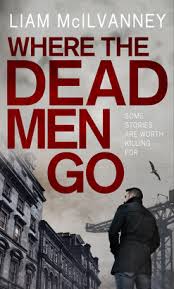
Where the Dead Men Go: Liam McIlvanney

Just got round to reading this,  second in what is being dubbed, breezily, 'Conway Trilogy 2', after an almost-quite-good-value £5 Kindle download. Just dear enough to annoy, just cheap enough to tempt. £12.99 reduced to nine quid for the paperback seems expensive too...

Anyway. I very much enjoyed All The Colours of The Town (see Thrillfilters passim) McIlvanney's debut thriller (Conway Trilogy 1) and wanted to find out what happened to Gerry Conway, ace Glasgow newshound and failing, guilt-ridden father. He's now getting another shot at fatherhood, with a new baby and a new New Zealandic bidie-in. He has, miraculously, become a PR man and then returned to what is clearly The Daily Record masquerading as The Herald. The book is nailed to 2011, oddly, and you would imagine from the negativity towards the medium of print that both those (real life) organs would be dead and buried by now. They're not, though McIlvanney's pessimisim regarding the future of newspapers, and his cynicism about their present, seems well founded, to me at least. Though if the Record and The Herald were to merge and become The Tribune, well...who knows?

What can I tell you about the plot? Jings. Murder, polis! Two rival gangland bigwigs fighting for supremacy. Corrupt council land deals and dodgy local politicians (hope McIlvanney had this properly legalled under Scots Law; there's some ready and uncomfortable identifiability with living local colour). A dead crime hack, Roma gangs in Govanhill. Paedophile prostitution. Grown-up prostitution. Assassins, Ulster terrorism and lashings of crisps and ginger beer! Actually, I meant malt whisky, wine and proper beer, old-school juicehead scribbler pubs, blues CDs and nice restaurants.

There is some brilliant descriptive writing but there's just a bit too much unlikely neon Taggartesque nonsense; things get cluttered and unconvincing towards the end. And the obsession with parenthood, lost children and fathers, inheritance and the visiting of second generation sins, becomes both distracting and in the end, a bit overwhelming. One minor detail: why is Glasgow and all its locii described with such loving, indeed moving accuracy, whereas Ayrshire's towns, coastal and inland, masquerade under pseudonyms?

I read this book a mere chucked brick from '27 Clouston Street', Gerry Conway's flat, loving the sense of place, the assured familiarity. I know present-day Govanhill a bit and I fear it was pantomimed slightly, the Roma issue somewhat caricatured. Kilmarnock and Prestwick were more than recognisable. Maybe Glasgow vibrates rather too colourfully throughout, and that is possibly a product of McIllvanney's southern hemisphere exile. Or Gerry Conway's prodigious appetite for booze, and nefarious habit of driving while well over the limit.

In conclusion: fascinating, not without its faults but addictive, stylish and just a wee bit too clever for its own good.

Saturday, 17 August 2013

Glasgow - in monochrome and colour


I really enjoyed Malcolm Mackay's The Necessary Death of Lewis Winter.  Its sheer, uncompromising oddness (enormous list of characters, with descriptions, before you could start; absolute refusal to deal with Glasgow's vernacular or geography; brutally cut-back prose. The cold, semi-autistic protagonist, Calum Maclean, up and coming gunman in Glasgow's divided crime scene.

It's part of a trilogy, and I was keen to read the sequel, How a Gunman Says Goodbye, featuring more about Calum's ageing mentor, Frank Macleod. There's the same long cast list at the start, now feeling even odder and somewhat ponderous, almost amateurish. And while the influences on Mackay are again obvious (Charles Willeford, James M Cain, Hammett, Derek Raymond) the book's velocity is slower than its predecessor's.

It's still a very good read, once you're committed to the stylistic quirks. But some of the more intimate situations described stretch credulity too far, and that rigid, laconic austerity in terms of location gives way to a sudden, throwaway pin-pointing of places. Renfrew. The South Side. The West End. The descriptions are over-long and tension is built too slowly. Only in the last section of the book do you become utterly locked in to Frank's fate and Calum's role in determining it.

Getting the sequels out quickly was obviously paramount in the publisher's mind. I can understand that they had a pulp pattern to follow and the third book is already being advertised in billboards on the Glasgow Subway. But How a Gunman Says Goodbye gives every indication of too much haste, and less-than-ruthless editing. Still weird and very readable though.

Liam McIlvanney's All the Colours of the Town was published two years ago and is also a thriller set in Glasgow. It too is part of a trilogy, I now discover, following the adventures of its central character, a journalist called Conway. The sequel, Where the Dead Men Go, is out in a couple of weeks.

McIlvanney is a very different writer from Mackay. He's an academic, a professor of Scottish literature in New Zealand. He has either a major family literary heritage to draw upon, or a big bad monkey on his back (or both) due to the fact that his old man is the godfather of tartan noir, William McIlvanney. And he loves, rejoices in, absolutely wallows in the glorious, sprawling detail of Glasgow. I suppose New Zealand would do that to a guy.

I loved All the Colours of the Town (only £1.19 for Kindle now. Just buy it!). It's convincing on internal newspaper politics, made me achingly homesick for the west end of Glasgow, and is one of the very few crime novels to tackle - and it does so with an impressive sense of history - west of Scotland sectarianism and its links to Northern Irish terrorism. While some of the writing is a tad florid and there is some Martin Amis-like verbal obscurantism, there are set pieces here that will stay with you forever: Trapped in a  car during an Orange Walk in Larkhall; the various sounds of a tenement close when you're unexpectedly left at home on a weekday.

Only the bad-dad-who-never-sees-his-wean aspect of Conway's life feels like genre furniture. The rest is very assured, extremely gripping and non-formulaic. As for the sequel, well. We shall see, shortly.

Saturday, 10 August 2013

Glasgow part one: Field of Blood.


The best 'Glasgow noir' books are, in my humble opinion: William McIlvanney's The Papers of Tony Veitch (just shading the same author's Laidlaw). Louise Welsh's The Cutting Room, and Frederic Lindsay's Brond. Only the last has been televised, and in an absolutely superb version directed by Michael Caton-Jones in the mid-1980s. There's a brief and not very dramatic clip on YouTube. 

But over the past few weeks I've found myself walking on the noir side of Glasgow courtesy of more recent tomes. And, having just returned to the Zetlandics after a brief sojourn back in my home city, watching BBC Scotland's Field of Blood took me back once more to the mean streets of the Dear Green Place.

Field of Blood was an odd experience. Its first outing (why are the BBC commissioning these compressed two-parters? The lamentable Shetland was another piece of televisual booksqueezing) passed me by completely, and for whatever reason I'd failed to realise it was set not just in Glasgow, but in the world of Glasgow newspapers in the 1980s. Not unfamiliar territory for me. The central character, Paddy Meehan, originates in the books of Denise Mina, of which I've read just the one, her first, Garnethill. I enjoyed it but never read anything else by her, and I'm not sure why. I've interviewed her for radio about music, and she was an absolute delight. But like Val McDermid and Alex Gray - I've read one novel each by them, too - the world of her prose was a place to which I didn't want to return.

Anyway, Field of Blood. I caught a trailer which was jaw-droppingly bizarre. It was like River City meets Life on Mars. Ford Kiernan! David Hayman! And, for goodness' sake, the great David Morrissey. All in the murky half-light of miner's strike Glasgow newsrooms, clubs and back alleys. I iPlayered the first episode and after wrestling with the self-consciously 'banteresque' dialogue at first, I began to enjoy it.

The plot was nonsensically, at times hilariously derivative, an amalgam of Bleasdale's GBH, the original State of Play (also featuring Morrissey) and (choose any episode) Taggart. But the look of the show was great, owing much to the TV adaptation of David Peace's Red Riding Quartet (featuring, ahem, David Morrissey) and the aforementioned Life on Mars (Season two, the Audi years). The cars were just about perfect (Citroen CX! Austin Princess 'Wedge'! Rover SD1!) and there was fastidious attention to detail in set design, from the Tunnock's Teacakes and early Macintosh computers to the ties, lapels and moustaches. The newsroom, though, was way too small.

There was a cartoonish element to the acting, but some of it was leeringly great, especially David Hayman as McDade, the miner's union boss. Katherine Kelley was marvellously OTT as the Armani-clad Rebecca Brooks from hell, and Morrissey reliably wide-lapelled. Ford Kiernan was all snappy one-liners hiding his  Great Inner Heartache and Vulnerability, but I warmed to his tanktops too.

Interestingly, this was written and directed by David Kane, who scripted the dismal pilot for (inexplicably recommissioned) Shetland. He's obviously far more at home on the mean streets of 80s Glasgow and in the sarcastic bastardin' verbals of the city too. The lack of time to develop character and foreboding, as in the magnificently sprawling Broadchurch, is a problem. But the seductive setting and full-on acting kind of compensate.

I liked it. In the end, it was no Red Riding or Shadow Line, and certainly no Brond, which was a strange, at times distressing and always disturbing take on the nature of evil-in-Glasgow, actually made in the era Field of Blood was set in, and paralleling its political plot in some ways. It isn't available to watch these days, though Lindsay's book, and its terrifying sequel Jill Rips (made into a movie starring, wait for it, Dolph Lundgren) are deservedly still in print.

Right, that's enough. I'll talk in due course about my other Glaswegian adventures, courtesy of Liam McIlvanney (son of) and Malcolm Mackay. But for now, have a look at Field of Blood on iPlayer while it's still available.

Wednesday, 3 July 2013

A Whisky in Monsterville


Tom Morton,author of this book, is, to be open and fair, the other contributor to Thrillfilter. He did not write this review


I HAVE a considerable experience of Loch Ness and environs, and although Tom Morton in A Whisky in Monsterville exaggerates the area's essential weirdness and overall eccentricity, he only does so to a certain extent. The dangerous nature of the road up the north side, he exaggerates not at all. I can personally vouch for dangerous overtaking on the way back from many a Crofters Commission hearing, at the wheel of many an unfamiliar self drive. You know the definition of a self drive? It's a car which can go places your own never could.

Hippies settled in the environs of the loch from the sixties and on. And long before that, people who would have been called drop outs, had the term been invented. Aleister Crowley was just the most famous dafty with piercing eyes.

We already met Morton's hero, Murricane in previous novel, Serpentine. He is special forces, and vastly experienced in situations involving mayhem. But good hearted, and endlessly,hoping for a quiet life. Such a life is not available, and you have to wonder if he really wants it. 

In any event it certainly isn't available to a man of principal who finds himself in a situation involving a loathsome American evangelist with creationism on his mind, a truly terrifying psycopath called,Jenks with appropriate, tidy, killing, and collecting on his, and his employer, an American billionaire, with a mind like a sewer, and a desire for some precious rare earths, which are under Loch Ness.

Not to mention a great deal of whisky, where Murricane, like the author himself, is an expert. In fact, each chapter of the book has an accompanying whisky or whiskey. As to what drinking them, chapter by chapter would be like, I can't help you to a view. Whisky, as understood today, was not invented when I quit the booze, 20 years ago.

It looks like pretty good stuff, but in my day, the whisky strap line was "Burny. Makes you drunk". Which was good enough for us, though we really preferred very treacly rum. We were, you understand, just one generation away from merchant seamen, and learned our drinking from them.

However, getting back from the highways and byways of sentimental reminisce, A Whisky in Monsterville. How does it rate. Highly, I think.

Unlike many of those who tread the best seller trail, Tom Morton is genuinely erudite, with an enviable breadth of knowledge covering music, literature, and a lot more of what makes  life worth living so all sorts of stuff crops up to lighten and enliven the narrative. To put it another way, the skeleton of the narrative is fairly standard. How could it be otherwise?

That narrative carries you professionally along. But meanwhile the book holds you in a way most in the genre don't, through well drawn characters, humour, and yes, erudition.