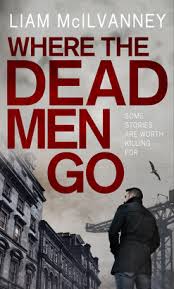
Just got round to reading this, second in what is being dubbed, breezily, 'Conway Trilogy 2', after an almost-quite-good-value £5 Kindle download. Just dear enough to annoy, just cheap enough to tempt. £12.99 reduced to nine quid for the paperback seems expensive too...
Anyway. I very much enjoyed All The Colours of The Town (see Thrillfilters passim) McIlvanney's debut thriller (Conway Trilogy 1) and wanted to find out what happened to Gerry Conway, ace Glasgow newshound and failing, guilt-ridden father. He's now getting another shot at fatherhood, with a new baby and a new New Zealandic bidie-in. He has, miraculously, become a PR man and then returned to what is clearly The Daily Record masquerading as The Herald. The book is nailed to 2011, oddly, and you would imagine from the negativity towards the medium of print that both those (real life) organs would be dead and buried by now. They're not, though McIlvanney's pessimisim regarding the future of newspapers, and his cynicism about their present, seems well founded, to me at least. Though if the Record and The Herald were to merge and become The Tribune, well...who knows?
What can I tell you about the plot? Jings. Murder, polis! Two rival gangland bigwigs fighting for supremacy. Corrupt council land deals and dodgy local politicians (hope McIlvanney had this properly legalled under Scots Law; there's some ready and uncomfortable identifiability with living local colour). A dead crime hack, Roma gangs in Govanhill. Paedophile prostitution. Grown-up prostitution. Assassins, Ulster terrorism and lashings of crisps and ginger beer! Actually, I meant malt whisky, wine and proper beer, old-school juicehead scribbler pubs, blues CDs and nice restaurants.
There is some brilliant descriptive writing but there's just a bit too much unlikely neon Taggartesque nonsense; things get cluttered and unconvincing towards the end. And the obsession with parenthood, lost children and fathers, inheritance and the visiting of second generation sins, becomes both distracting and in the end, a bit overwhelming. One minor detail: why is Glasgow and all its locii described with such loving, indeed moving accuracy, whereas Ayrshire's towns, coastal and inland, masquerade under pseudonyms?
I read this book a mere chucked brick from '27 Clouston Street', Gerry Conway's flat, loving the sense of place, the assured familiarity. I know present-day Govanhill a bit and I fear it was pantomimed slightly, the Roma issue somewhat caricatured. Kilmarnock and Prestwick were more than recognisable. Maybe Glasgow vibrates rather too colourfully throughout, and that is possibly a product of McIllvanney's southern hemisphere exile. Or Gerry Conway's prodigious appetite for booze, and nefarious habit of driving while well over the limit.
In conclusion: fascinating, not without its faults but addictive, stylish and just a wee bit too clever for its own good.
Showing posts with label McIlvanney. Show all posts
Saturday, 14 September 2013
Where the Dead Men Go: Liam McIlvanney
Labels:
Conway,
crime,
Glasgow,
Govanhill,
McIlvanney,
newspapers,
Roma
Saturday, 17 August 2013
Glasgow - in monochrome and colour
It's part of a trilogy, and I was keen to read the sequel, How a Gunman Says Goodbye, featuring more about Calum's ageing mentor, Frank Macleod. There's the same long cast list at the start, now feeling even odder and somewhat ponderous, almost amateurish. And while the influences on Mackay are again obvious (Charles Willeford, James M Cain, Hammett, Derek Raymond) the book's velocity is slower than its predecessor's.
It's still a very good read, once you're committed to the stylistic quirks. But some of the more intimate situations described stretch credulity too far, and that rigid, laconic austerity in terms of location gives way to a sudden, throwaway pin-pointing of places. Renfrew. The South Side. The West End. The descriptions are over-long and tension is built too slowly. Only in the last section of the book do you become utterly locked in to Frank's fate and Calum's role in determining it.
Getting the sequels out quickly was obviously paramount in the publisher's mind. I can understand that they had a pulp pattern to follow and the third book is already being advertised in billboards on the Glasgow Subway. But How a Gunman Says Goodbye gives every indication of too much haste, and less-than-ruthless editing. Still weird and very readable though.
Liam McIlvanney's All the Colours of the Town was published two years ago and is also a thriller set in Glasgow. It too is part of a trilogy, I now discover, following the adventures of its central character, a journalist called Conway. The sequel, Where the Dead Men Go, is out in a couple of weeks.
McIlvanney is a very different writer from Mackay. He's an academic, a professor of Scottish literature in New Zealand. He has either a major family literary heritage to draw upon, or a big bad monkey on his back (or both) due to the fact that his old man is the godfather of tartan noir, William McIlvanney. And he loves, rejoices in, absolutely wallows in the glorious, sprawling detail of Glasgow. I suppose New Zealand would do that to a guy.
I loved All the Colours of the Town (only £1.19 for Kindle now. Just buy it!). It's convincing on internal newspaper politics, made me achingly homesick for the west end of Glasgow, and is one of the very few crime novels to tackle - and it does so with an impressive sense of history - west of Scotland sectarianism and its links to Northern Irish terrorism. While some of the writing is a tad florid and there is some Martin Amis-like verbal obscurantism, there are set pieces here that will stay with you forever: Trapped in a car during an Orange Walk in Larkhall; the various sounds of a tenement close when you're unexpectedly left at home on a weekday.
Only the bad-dad-who-never-sees-his-wean aspect of Conway's life feels like genre furniture. The rest is very assured, extremely gripping and non-formulaic. As for the sequel, well. We shall see, shortly.
Labels:
crime,
gangland,
Glasgow,
Mackay,
McIlvanney,
tartan noir,
thriller
Subscribe to:
Posts (Atom)


