Sunday, 8 December 2013

Rabb, Rosa Luxembourg and some wee anachronisms...

Drew Ratter on another chronicler of the inter-war years...


Rosa
Jonathan Rabb

Jonathan Rabb is American,but doesn't really feel it, any more than does Alan Furst or Philip Kerr, respectively American too, and Scottish, respectively. They appear to be sort of international initiates in some arcane brotherhood of the interwar years, more specifically the sept which psychically exists in Germany and Eastern Europe.

Rabb is the least prolific of the three, all young men. He is also formally the most academic. Both his parents and most of his grandparents were historians, so it seems, and he gravitated naturally to Yale and Columbia.

His early life as a historian imbues his Berlin trilogy. The immediate post war period is meticulously delineated, and Kriminal Kommissar Hofner works out of the Alex; very familiar to friends of Kerr's Bernie Gunther (who, as a character lives much more strongly in my head, by the way).

The Rosa of the title is the murdered socialist leader Rosa Luxemburg, who so tragically overestimated the internationalism of the industrial proletariat. Other historical figures flit in an out, mingled with the fictional players, Karl Liebknecht naturally, as a corpse, but lesser known socialists and heroes of the Spartacus League like Leo Jogiches flit about, half seen, in the wings. Jogiches then turns out to be crucial.

As well as the heroes, of which there are but few, there are villains. Many villains, easily available, as we are well aware given the era, and the fact that by the early 1930s, a mere decade later, evil had comprehensively triumphed in Germany. Included are not only members of the Freikorps, who were the backbone of the SS, but also the natural foe of the Kripo, the criminal police, the Polpo, the political police. Thereafter, this latter organisation became the basis for the Gestapo
The hook is the fact that there have been constant doubts expressed about whether the shot and bludgeoned corpse examined following its discovery was really that of Luxemburg. DNA analysis in 2009 did not, as anticipated, clear up the whole mystery.

A good read, overall, with  a strange and worrying lace-obsessed murderer with perhaps a slight hint of Jean Baptiste Grenouille? But then, he doesn't turn out to be so central after all.

And so it redoubles and redoubles. The final verdict? Vastly learned, but rather longwinded. And the anachronisms..............even up to and including "So we're good here"

Wednesday, 20 November 2013

When Rebus met Bond: The Nine Quid Tesco Showdown


So I'm in Tesco (Big Huge version) in Glasgow's Maryhill, shopping, as ever during visits to the various offspring and grand-offspring, for cheap socks and to see if there's a discount on Duvel Golden Ale.

Now I know it's morally wrong to buy books in supermarkets. You should buy them in quaint independent stores where the charmingly irascible owner sits knitting, you get bad free instant coffee and the shelves are collapsible climbing hazards for toddlers. And a new lump of hardback fiction costs £18.99.
But the Rankin and the Boyd (and it's very much a Boyd) under consideration here were £9 apiece in the Big T. Less than half RRP. I'm sorry, but that's paperback pricing and, for an itinerant bibliophile suffering a late allergic reaction to Kindles of all shades, irresistible. So, no cheap Duvel, but I exited with hosiery and fictive skulduggery.

Boyd first, and Solo is the latest in the Fleming Estate's commissions of fresh Bondage by established contemporary authors. Step forward with a riddy, Sebastian Faulks. It is by some considerable distance the best post-Fleming Bond, and is arguably better than some of Fleming's own efforts. Faultless, no, but a splendid read nevertheless. And I admit that I was biased, in that Boyd's Any Human Heart is among my favourite novels of the past two decades and his Restless one of the slickest lit-thrillers I've read.

We find Bond in 1969, ageing but still indulging himself in booze, cars, fags and sex to a mordantly entertaining degree. At first I thought he was going to die of throat cancer by the last chapter. But no, that's just one of Boyd's little teases. He has Fleming's approach to Literary (not filmic) Bondworld nailed down with the exactitude of the real fan - all the brand names, gun-tech, anal-retentive car love and curiously coy randiness. But while it comes close to pastiche, this is no tedious tribute. Boyd's own deep affection for and knowledge of Africa provides the main setting and a degree of political insight which is both relevant to today and truly tough-minded. This Bond is much more socially engaged than Fleming's ever was, sympathetic and merciful, concerned and generous. And strangely vulnerable, even weak on occasion. Yes, the book has a truly horrible supervillain, and two women offering varieties of voluptuous charm. Bond has a form of very violent revenge but his triumph is questionable.

It's a compulsive read, but it's cool, not cold as Fleming's near-psychopathic creature was. It's on reflection after completion that the little references and resonances surface: The Jensen FF/Interceptor conundrum – a fly nod to Simon Dutton in The Saint and Robert Vaughan's The Protectors, and the car Bond never drove either on the page or in a movie. The eerie non-assassination's hints of both Deeley Plaza and (curiously out of print) The Day of theJackal. The CIA agent called Brigham, the wee tip of the hat to Puppet on a Chain by the great Alistair Maclean, and others I will leave you to find for yourself. Plot is where it falls down slightly, the explanation at the end by Felix Leiter just a bit too clunky to be meant ironically. But Solo is very good, bibulous company.

And so to Edinburgh, where Bond was of course educated (and there's loads of Caledonian references in Solo) and a somewhat earthier approach to drink. Ian Rankin's Saints of the Shadow Bible uses a Jackie Leven quote as its title, as opposed to a misheard Leven lyric as the name of Rebus's previous outing, Standing In Another Man's Grave.

I thought SIAMG was a great read, and seemed looser and more playful than previous Rankins, with its whimsical road movie/whisky tour elements. It shared with his other books, though, one of Rankin's major strengths, which is more than an ability to evoke a sense of place. His books are properly located, not just in their excellent capturing of geography - the sights, smells, sounds and people – but in time, too. Saints of the Shadow Bible is set in today's Scotland, and both police reorganisation and the referendum debate inform and enliven the plot, giving it depth and edge.

There are clever TV references as well as the usual musical ones (the late Rory Gallagher's Sinner Boy at one point, providing synergy with the Rankin/Gallagher project Kickback City). Life on Mars is 'a documentary' when it comes to 70s policing. Rebus seems to be heading for an alcohol crisis (but when wasn't he?), and there are hints that healthy living may be staring him in his broken-veined face: Soda water and lime? Jings! Am I detecting a wee wink at Psycho, too? To say more would give too much away.

The book has one of the best-engineered plots of recent Rankins, and the bringing together of Rebus with Fox, his in-house adversary and main protagonist of the Complaints books, works brilliantly, paving the way I'd guess for future collaborations between the two. But as with Boyd's Bond, the use of branded detail is note-perfect (particularly good on using cars to define characters: eg a wonderfully awful white Range Rover Evoque) and there are some very funny moments.

Some people swear that Black and Blue is Rankin at the top of his form, but I prefer the assured delicacy of touch, complexity, humour and casual verve you find here. By now we know all the central characters – Rebus, Fox, Clarke – their quirks, foibles and annoying tics. And crucially, we care what happens to them.

Enough to pay nine quid for the next hardback...


Wednesday, 16 October 2013

Duet in Beirut, by Mishka Ben-David: when authenticity is more than illusion

The question of authenticity hovers over all spy thrillers and crime fiction. But it's not reality we crave, it's the sense of it. The illusion of reality, if you like, so long as it's believable.

An author creates a world. We inhabit it, temporarily, accepting, if the writer is good at his or her job, its rules, regulations, the needs, wants, desires and motivations of the characters who live there. Because what we want is a story. A story that takes us away from our everyday concerns and absorbs us in other, more exciting ones.

So the novelist is essentially playing a trick.  On us, and sometimes on him- or herself too. I'm always slightly amused by the furrowed-brow method-acting 'research' which leads the creators of some, essentially lightweight entertainments to give themselves over to weeks and months of taking notes rather than writing. In a lot of cases, I'm sure it's (a) a tax-allowable excuse for hanging out with interesting folk, sometimes in glamorous foreign locations, eating and drinking extremely well; (b) a way of avoiding actually writing and (c) a method of getting out of the house. The craving of some readers, particularly in hardware-obsessed, anally-retentive macho fiction, for details of armaments, map references and cars, and in other fields for nit-picking restaurant menus and recipes (I count myself vulnerable on all counts here) allows writers to shortcut to believability through apparent knowledge of catalogue detail. Or sometimes, effective Googling.

What of the writers, though, who actually have personal experience of the extreme activities they write about? Frankly, it doesn't mean two empty chambers in a Walther PPK if they can't write. If they can't convince. 'The myth of experience' one screenwriter of my acquaintance calls it. The notion that just because you know something happened, if you were actually there, the reader/viewer has to believe your story.

John Le Carre is often cited as someone whose secret service career informs his writing, lends it a sheen of respect. Maybe, in his early books. But what carries you through a good Le Carre (and there are some duds) is the literary skill and verve, the atmosphere, the insight into characters, the moral stance which in latter years has become outrage. Stella Rimington, on the other hand, former head of Mi5, writes slight, workmanlike thrillers that never transcend the evident verisimilitude of some sequences. They're basically dull.

Among the dozens of former CIA officers who have turned their skills in dissembling to fiction, Charles McCarry is perhaps the most interesting, paralleling Le Carre (even in name) and in his prescient 1979 novel The Better Angels, predicting Islamic terrorism and passenger aircraft attacks similar to 9/11. With a recent book, The Shanghai Factor, centred on China's use of multinational companies for intelligence purposes, his contemporary relevance remains. But as he says, what he does is produce 'stories...largely imagined, but not entirely so.' McCarry has a mordant gift for taking real events and twisting them into very odd shapes indeed, notably the Kennedy assassinations in The Tears of Autumn.

All of which takes me to the recent publication, for the first time in English, of Mishka Ben-David's superb Duet in Beirut. Ben-David was a Mossad officer for 12 years, and Duet in Beirut was written as a screenplay not long after he left the Israeli secret service (which the book indicates is more like a cross between Mi6 and the SAS, with planned undercover military actions a big part of its remit).

Brilliantly translated from the original Hebrew by Evan Fallenberg, the book deals with a rogue agent who tries to make amends for a previous failure by assassinating, without permission, a senior Hezbollah figure in Beirut. His former mentor goes after him, followed by a hastily-assembled undercover team, but the book's amazing insider detail is matched by beautifully (re)created characters, families and locations, plus an utterly convincing portrayal of the inner wranglings of a secret service, and the political context in which it operates.

There are odd plot echoes of The Bourne Identity movie and  you can pick up  resonances from other films too, especially Syriana and of course Munich, but the book's building of tension and pace until the almost unbearable finale is exemplary, cool and very accomplished. Some may find the quite explicit and sentimental Zionism of at least one character difficult, but in the end, this is among the very best and most revealing spy novels I've read. And it works because a gifted author has harnessed his experience to tell a great tale very well indeed.

Sunday, 22 September 2013

Dominique Manotti: Rough Trade


Dominique Manotti is a pseudonym, which sort of sets the tone for, the book, where rough trade equally defines a child prostitution ring, and the garment trade in Paris, 1980, where the workers are Turkish, and illegal. The book is available on Kindle and in paperback.

The police are corrupt and brutal, yet somehow maintain a moral compass of some kind, in the bigger issues, if not the small. Can we say beating, and even occasionally raping suspects are small things? Moral analysis must be tackled by the reader. It does not seem to be something the author spends much time on.

The people the police are up against are pretty terrifying, remember. In the late 1970s-mid 1980s, the Grey Wolves, fascist and ultra nationalist, unofficial militant arm of the Nationalist Movement Party in Turkey were active, murdering and torturing in their own country, but also in a lot of European states. Outstandingly bad people, and still cropping up to this day.

It seems it is always a bad idea taking on Turks. They fight, as many groups do, but they seem to have a predilection for organising, which many don't. The British and Commonwealth armies found that out in 1915 and 1916. Another interesting note. During the Korean War, a significant number of British and American prisoners failed under the tremendous pressure, and became informers and fellow travellers. Turks? Not a single one.

The action in Rough Trade takes place over a single month in 1980, with a great deal of cinematic jump cutting. The focal point is police headquarters, the evocatively named Passage de Desire.

One problem early on is keeping track. There are a couple of reasons for this. First, multiple strands. Second, it is difficult distinguishing the policemen, who don't have much in the way of distinctive features. Apart from Daiquin, senior, and the central character, who is gay, and who initially coerces a Turkish militant, and then falls in love with him.

By the middle of the book, the confusion has abated, and the action compels. There are more of these Manottis, but translation has not caught up yet. Worth watching out for.

Drew Ratter

Saturday, 14 September 2013

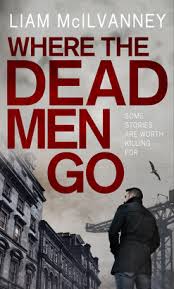
Where the Dead Men Go: Liam McIlvanney

Just got round to reading this,  second in what is being dubbed, breezily, 'Conway Trilogy 2', after an almost-quite-good-value £5 Kindle download. Just dear enough to annoy, just cheap enough to tempt. £12.99 reduced to nine quid for the paperback seems expensive too...

Anyway. I very much enjoyed All The Colours of The Town (see Thrillfilters passim) McIlvanney's debut thriller (Conway Trilogy 1) and wanted to find out what happened to Gerry Conway, ace Glasgow newshound and failing, guilt-ridden father. He's now getting another shot at fatherhood, with a new baby and a new New Zealandic bidie-in. He has, miraculously, become a PR man and then returned to what is clearly The Daily Record masquerading as The Herald. The book is nailed to 2011, oddly, and you would imagine from the negativity towards the medium of print that both those (real life) organs would be dead and buried by now. They're not, though McIlvanney's pessimisim regarding the future of newspapers, and his cynicism about their present, seems well founded, to me at least. Though if the Record and The Herald were to merge and become The Tribune, well...who knows?

What can I tell you about the plot? Jings. Murder, polis! Two rival gangland bigwigs fighting for supremacy. Corrupt council land deals and dodgy local politicians (hope McIlvanney had this properly legalled under Scots Law; there's some ready and uncomfortable identifiability with living local colour). A dead crime hack, Roma gangs in Govanhill. Paedophile prostitution. Grown-up prostitution. Assassins, Ulster terrorism and lashings of crisps and ginger beer! Actually, I meant malt whisky, wine and proper beer, old-school juicehead scribbler pubs, blues CDs and nice restaurants.

There is some brilliant descriptive writing but there's just a bit too much unlikely neon Taggartesque nonsense; things get cluttered and unconvincing towards the end. And the obsession with parenthood, lost children and fathers, inheritance and the visiting of second generation sins, becomes both distracting and in the end, a bit overwhelming. One minor detail: why is Glasgow and all its locii described with such loving, indeed moving accuracy, whereas Ayrshire's towns, coastal and inland, masquerade under pseudonyms?

I read this book a mere chucked brick from '27 Clouston Street', Gerry Conway's flat, loving the sense of place, the assured familiarity. I know present-day Govanhill a bit and I fear it was pantomimed slightly, the Roma issue somewhat caricatured. Kilmarnock and Prestwick were more than recognisable. Maybe Glasgow vibrates rather too colourfully throughout, and that is possibly a product of McIllvanney's southern hemisphere exile. Or Gerry Conway's prodigious appetite for booze, and nefarious habit of driving while well over the limit.

In conclusion: fascinating, not without its faults but addictive, stylish and just a wee bit too clever for its own good.